Today I’m trying something completely new here on the blog, for the very first time, I’m handing over the reins for a guest post. And honestly, I couldn’t think of anyone better to trust with it than the very capable hands of Catherine from Catherine Crochets.
I first met Catherine at the Crochet Sanctuary back in December 2022, and you may remember that I interviewed her for the blog shortly afterwards (you can read that interview here). Since then, we’ve kept in touch over socials, and I’ve continued to admire both her creativity and her knowledge of crochet.
So today, I’m delighted to bring some of Catherine’s wealth of expertise on blanket making to the blog. Whether you’re just getting started or already have a pile of cosy creations to your name, I know you’re going to love what she has to share. So, without further ado… I’m going to hand you over to Catherine!
Pin for later:

The Technique That Sparked My Blanket Journey (And Might Just Spark Yours)
The first tapestry crochet project I ever made was not a blanket. It was a small geometric accessory – a bag or a mat, I think – and I remember looking at it when it was finished and thinking: that would be extraordinary across a full blanket.
So I tried it. I picked a few geometric patterns, sketched them out on some squared paper, and spent a happy few weeks making what became my Geo Georgie Blanket – a collection of diamonds, triangles and zig-zags worked in tapestry crochet.
It started as a bit of an experiment, really: I wanted to see how the technique would behave at blanket scale, and whether the designs I had in mind would translate. But I absolutely loved making it. The photos got a wonderful response when I shared them, and before I quite knew what was happening, the pattern was being tested and I was releasing my first ever blanket design. I also finished it with a head full of ideas – designs I wanted to try next, motifs I hadn’t explored yet, new ways of working the technique. That feeling hasn’t ever really left me since.

That was the beginning of what has become my primary design focus. Since then, I’ve designed tapestry crochet blankets worked in rows, in the round, and from square and hexagon motifs. I’ve explored geometric patterns, botanical designs, and more pictorial, figurative work.
My Midnight Diamond Blanket, which also started off as a bit of an experiment, has now been made by over 3,000 crocheters, which still feels fairly remarkable to me. And the technique continues to surprise me with what it can do.

I’m sharing all of this with you because I know tapestry crochet has bit of a reputation for being complicated or tricky. And I want to gently push back on that.
What tapestry crochet actually involves
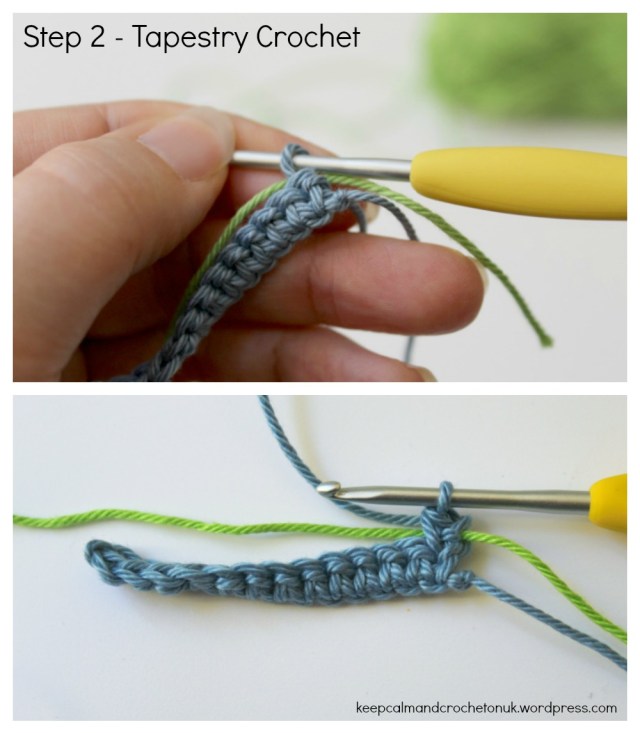
At its heart, tapestry crochet is a colourwork technique. You work with two or more colours at the same time, crocheting over the unused strand so it’s neatly enclosed within the stitches, rather than left as a float on the back, as you might see in some knitting colourwork. The result is a clean, structured fabric with the graphic design visible on both sides – and a much tidier back than you might expect from a colourwork technique.
You can work tapestry crochet with any stitch, and the choice affects how the finished fabric looks and behaves. I most often use UK treble (US double crochet) in my blankets, though some designs call for half treble (US half double) crochet or extended double (US single crochet) depending on the stitch proportions I want to use, the yarn I’m using, and the feel or drape I want to create.

If you can already work basic crochet stitches and change colours, you have the core skills. The rest is about managing your carried yarn and following the colour instructions – both of which are more straightforward than they sound.
My patterns are primarily written instructions: for each row, you simply follow the stitch counts step by step, working the colours as directed. I also include a chart alongside the written pattern – a grid where each square represents one stitch and the colour of the square tells you which yarn to use. It’s very similar to following a cross stitch chart, if you’ve ever done that. Some people prefer to work entirely from the written instructions; others like to use the chart alongside them, or switch between the two. Either way, once you’ve worked a row or two, the rhythm becomes quite natural.
One technique, a remarkable range of results
This is something I find genuinely exciting about tapestry crochet: the design possibilities are enormous, and so is the range of construction methods you can use, each of which opens up different kinds of colourwork pattern. A blanket also gives you real space to work with. A small accessory gives you a glimpse of a design; a blanket lets it breathe and develop across a much larger canvas, which is part of why I find the two such a natural combination.
Working in rows is the most straightforward place to start. It lends itself well to geometric designs but can also handle softer or more figurative designs really well too. The simplicity of back-and-forth rows makes it easy to build confidence while still producing something that looks genuinely striking. My Jora Blanket is a good example: a clean geometric pattern in rows, with a repeat that becomes almost meditative once your hands know it.

Working from motifs
Squares or hexagons open up a whole other set of possibilities. Designs with rotational symmetry work beautifully as individual motifs: flowers, stars, snowflakes, and geometric shapes that radiate from a centre all sit naturally within a square or hexagon format. But one of the things I love most about the motif approach is what can happen when you join them. The colourwork pattern doesn’t have to stop at the edge of each tile – it can be designed to continue across the joins, so the finished blanket reads as one large, flowing design. The effect is a bit like decorative ceramic tiles, where the pattern seems to extend endlessly across the surface.
Working in the round
Treating the whole blanket as one large piece worked outward from the centre produces results that are quite different again. My Cara Blanket is a good example: a square baby blanket with a ring of hearts that radiates outward as you work. This construction suits designs where the pattern builds concentrically – hearts, leaves, trees, or other motifs that you want to place at the heart of the blanket and surround with complementary rounds of pattern.

And across all of these construction methods, the subject matter of the colourwork can range widely. Tapestry crochet handles clean geometric shapes beautifully, but it’s equally capable of softer, more organic forms like botanical designs, leaf shapes, and gentle curves. With a little chart planning, you can even work figurative or pictorial designs: fish, trees, and even people. The technique is far more flexible than its reputation suggests.
A word of warning
There is one quality of tapestry crochet that I should probably mention, in the spirit of full disclosure: it is genuinely addictive in a way that other techniques aren’t quite so much.
The reason for this, I think, is the colourwork. Because you’re watching a design emerge stitch by stitch, there’s always a reason to work just one more row or round. The pattern reveals itself gradually – a diamond beginning to form, a star coming into focus, a border starting to click into place – and it’s very hard to put down when you can see that another row will show you just a little more. I have lost more evenings than I care to admit to this particular quality of the technique. Consider yourself warned.

The things that trip people up (and how to avoid them)
There are a few areas where tapestry crochet beginners tend to struggle, and I’d rather mention them now than leave you to discover them mid-project.
Yarn tangling is the thing people often worry about most – and it’s also the most preventable. The key is to keep each yarn ball in a consistent position relative to your work, and to always pick up each colour from that same position. When you do this, the yarns never cross, so they never tangle. This short video tutorial shows exactly how it works in practice.
The carried yarn showing through is the other thing worth understanding before you begin. Because the unused yarn is carried inside your stitches, the goal is to keep it as well hidden as possible, although a little showing through here and there is generally fine in practice. It can add to the overall visual texture, and at the natural viewing distance of a finished blanket it’s rarely noticeable at all. That said, it’s still worth knowing the techniques that minimise it, since the results will be cleaner and more even.
There are four main things that help:
- giving the carried yarn a gentle tug each time you pick it up (to seat it snugly behind the stitches just worked);
- using a slightly smaller hook than your yarn label suggests;
- choosing a smooth yarn with good stitch definition; and
- thinking carefully about colour combinations, since a light yarn carried behind dark stitches is always going to be harder to conceal than colours that are close in tone.
I’ve written a full guide to hiding the carried yarn in tapestry crochet if you’d like to explore this further.

Where to start
For choosing a first project, I’d suggest looking through my guide to the best tapestry crochet blanket patterns for beginners, which walks through what to look for and includes some specific recommendations. In short: a two-colour design with a simple repeating pattern is a much more enjoyable starting point than something with multiple colours and a complex chart – and the result will still be something you’re genuinely proud of.
If you’d like to explore the technique more broadly, I have a full tapestry crochet resource hub on my website, covering everything from reading charts and choosing yarn to construction methods and finishing.
And if you’d like to try a smaller first tapestry project, I’d love you to join my email list. When you sign up, you’ll receive two free patterns chosen specifically as introductions to tapestry crochet. One is a scarf worked in rows and the other is a square motif with a star design, so you can explore both approaches and see which suits you best. You can sign up to receive the free patterns here.
Tapestry crochet opened up a whole world of creative possibilities I hadn’t imagined when I first picked it up. I hope it does the same for you.

Catherine designs crochet blankets and accessories, with a particular focus on tapestry crochet and colourwork. Her patterns are published on Etsy and Ravelry, and she has designed for Sirdar and WeCrochet. She has also been published in crochet magazines and the book 100 Crochet Tiles. You can find her tutorials, resources and patterns at catherinecrochets.com.
A huge thank you to Catherine for sharing her time, expertise, and creativity in this guest post – it’s been such a pleasure to feature her work here on the blog.
I hope you’ve enjoyed this closer look at tapestry crochet, it’s definitely inspired me to try more of the technique myself at some point, especially after seeing just how many creative possibilities it opens up.
Until next time folks! Happy hooking, keep calm and crochet on my friends xx

P.S. Make sure you’re subscribed to the blog (below) and/or my mailing list to stay updated on new blog posts, pattern releases, and exclusive discounts!
Subscribe to the blog: